
Uncategorized
Raw Cambodian Hair Vendors: Sourcing & Quality Verification Guide (2026)
Aug
Demand for raw, unprocessed hair is growing, but the market is also crowded with hair mislabeled as “raw Cambodian.” For salon owners and wholesale buyers, finding a trustworthy raw Cambodian hair vendor requires more than comparing photos or prices.
This guide explains how authentic Cambodian hair is sourced, why it is relatively scarce, how it compares with Vietnamese and Indian hair, and how to verify quality before placing a wholesale order.
Market Realities: The Structural Scarcity of Raw Cambodian Hair
Authentic Cambodian hair is relatively scarce because its supply chain is smaller and more fragmented than those of major hair-producing markets such as India and Vietnam.
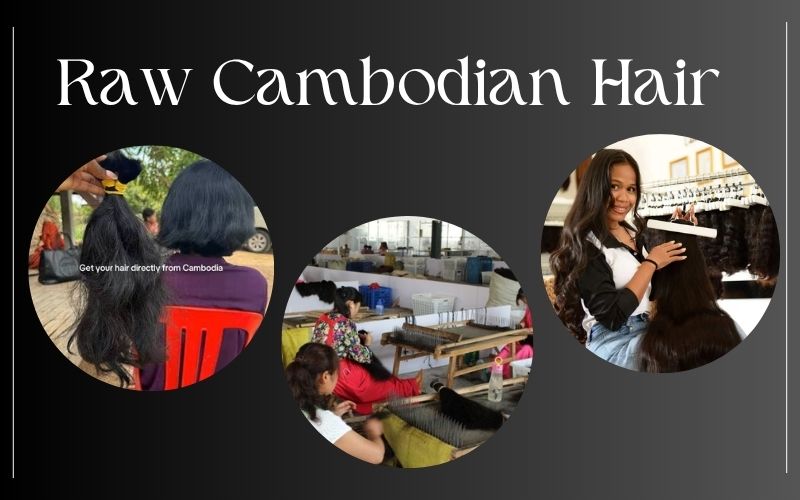
Rather than relying on large centralized collection systems, Cambodian hair is typically sourced through direct, personalized transactions with individual donors. Collection teams travel to rural provinces and purchase hair directly from people who voluntarily sell it. The hair is then gathered, sorted, and prepared for manufacturing.
This differs from India, where temple tonsuring provides large volumes of hair that can enter centralized auction and processing networks. Vietnam also has a highly developed hair-export industry with large-scale collection and manufacturing capacity.
Cambodia simply cannot provide the same volume. Its smaller population, limited donor pool, and localized collection networks make it difficult to consistently source large quantities of genuine raw hair. For buyers, this natural scarcity is one reason authentic Cambodian hair can command a premium and why suppliers may struggle to scale a 100% Cambodian hair product line.
It also creates an incentive for mislabeling. Some suppliers may market lower-cost Indian, Chinese, or processed hair as “raw Cambodian” to capture higher margins.
For this reason, choosing among raw Cambodian hair vendors should involve more than checking where a company is located. A supplier based in Cambodia is not automatically selling Cambodian-origin hair. Buyers should ask where the hair is collected, how it is processed, and whether the supplier can demonstrate a transparent sourcing chain.
For salon owners and distributors, traceability is ultimately more valuable than a “Cambodian” label alone.
Physical Mechanics & Performance: Cambodian vs. Vietnamese vs. Indian Hair
Hair origin can influence the physical characteristics buyers experience, but origin should not be treated as a guarantee that every bundle from a particular country will behave identically.
The supplied framework identifies several useful distinctions between raw Cambodian, Vietnamese, and Indian hair:
| Structural Compare | Raw Cambodian Hair | Raw Vietnamese Hair | Raw Indian Hair |
| Fiber Diameter & Feel | Medium-to-coarse, with noticeable natural friction | Sleek, silky, and smooth with relatively low cuticle resistance | Fine, soft, and highly flexible |
| Density & Volume | Relatively light strands that can expand into high visual volume | Heavy, dense strands that tend to create a sleek, flat silhouette | Variable density with a naturally lightweight body |
| Dye & Bleach | Moderate; generally better suited to warm blonde/brown lifting | Strong lifting potential, including platinum-blonde applications such as #613 | Variable; excessive bleaching may lead to thinning |
| Curl Retention Style | Strong curl retention due to coarser fiber characteristics | Moderate; straight structures may release heat curls more quickly | Adaptable to straight, wavy, and deep-curly styling |
| Sourcing Supply | Scarce, with localized collection networks | Plentiful, supported by larger manufacturing networks | Extremely abundant, with centralized collection and auction systems |
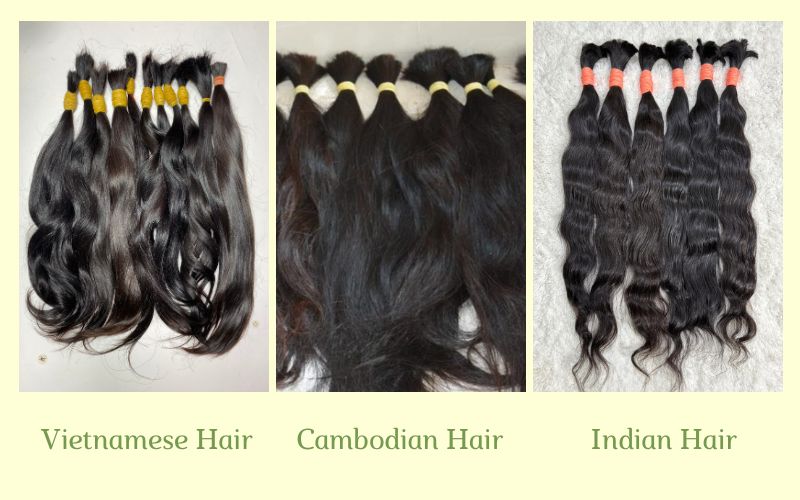
These differences help explain why a salon may prefer one origin over another.
Visual Volume vs. Strand Weight: The Density Myth
One common misunderstanding is that heavier hair must automatically create more volume.
Physical weight and visual volume are not necessarily the same thing.
The supplied comparison describes Vietnamese raw hair as having high linear density. Its dense structure can make individual bundles physically heavier while allowing the hair to lie relatively flat. The result can be a smooth, sleek silhouette.
Raw Cambodian hair is described differently. Its fibers are lighter per unit length but can have a naturally wavy, three-dimensional structure. When installed, those fibers interact with one another and occupy more visual space.
This can create substantial body without requiring the same physical weight on the scalp.
For customers who want textured, voluminous extensions rather than an ultra-flat appearance, this characteristic can be particularly attractive.
The key takeaway is that buyers should evaluate volume after installation, not simply compare bundle weight.
Tactile Friction & Curl Retention
Another characteristic associated with raw Cambodian hair is its medium-to-coarse fiber profile.
Natural friction between the fibers can help the hair hold a styled shape. For clients who regularly use curling irons or other heat tools, this may translate into better curl retention compared with very smooth, straight hair structures.
The advantage is not necessarily that Cambodian hair is “better” than every other origin. Rather, its physical characteristics can make it particularly suitable for customers who want texture and lasting curls.
Buyers should still evaluate individual samples because donor characteristics, length, texture, and processing history can all affect performance.
Bleaching and Lifting Capabilities
Coloring is another area where origin and fiber characteristics become important.
The supplied comparison describes raw Vietnamese hair as having strong lifting potential and being capable of reaching very light shades such as platinum blonde (#613) when handled appropriately.
Standard raw Cambodian hair is presented as having more moderate lifting capacity. This does not make it unsuitable for coloring, but high-lift bleaching should be approached cautiously and preferably performed by a professional.
For a salon buyer, the safest approach is to test the exact hair you intend to purchase rather than assuming that every bundle from a particular geographic origin will respond identically to bleach.
Sourcing Channels: Direct Factories, Intermediary Processors, and Western Boutique Brands
The market for wholesale raw hair vendors can be divided into several broad supply tiers. Understanding where a vendor sits in the supply chain can make it easier to compare price, transparency, customization, and minimum-order requirements.
1. Direct Cambodian Factories (Boutique & Ethical Sourcing)
Direct Cambodian factories are positioned closest to the country’s localized collection networks.
Some typical suppliers:
- Apsara Cambodian Hair
- Angkor Cambodian Hair
- Cambodian Hair Extensions
- The Elect Cambodian Hair.
These businesses are described as operating in or around major Cambodian commercial centers such as Siem Reap and Phnom Penh. Their potential advantage is proximity to the source.
A direct factory may manage collection teams, sorting, quality control, and wefting under one supply structure. For wholesale buyers, this can potentially provide greater visibility into how raw material becomes finished hair.
However, buyers should still conduct their own verification. A supplier describing itself as a “direct Cambodian factory” should be able to demonstrate its physical operation, inventory, sorting process, and production capabilities.
2. Intermediary Regional Processors (Vietnam & China Hubs)
A second supply tier consists of larger manufacturing companies operating in established production hubs.
Vietnamese manufacturing centers such as Hanoi and Bac Ninh have significant experience producing hair extensions, wigs, closures, frontals, and related products.
Some typical suppliers:
- APOHAIR
- Lyn Hair
- Ovi Hair
- Cyhair
Chinese manufacturing hubs are also prominent in the global hair-extension supply chain.
Some typical suppliers:
- Rebecca
- Fuxin Products
- Qingdao G-Easy.
Regional processors can offer advantages in manufacturing capacity, product variety, logistics, and customization. They may be able to convert bulk raw material into a much broader selection of finished products than a small boutique collection operation.
The important question for a buyer is origin.
If Cambodian raw material has been imported into another country for processing, the finished bundle should not automatically be treated as equivalent to hair collected and manufactured directly at the Cambodian source.
Buyers should also investigate whether different grades or origins are blended within the same product line.
3. Premium Western Distributors (Salon & Retail Buffers)
The third category consists of Western brands and distributors that purchase or manufacture hair and then sell directly to salons and consumers.
Some typical suppliers:
- Yummy Extensions
- DHair Boutique
- Chandra Hair
- KingRich Luxury.
Their main advantages are convenience, domestic shipping, customer support, and established retail quality-control systems.
The trade-off is that many operate primarily around direct-to-consumer sales. They may not be structured to supply large quantities of raw bulk hair directly to salon owners or wholesale distributors.
For a buyer building a long-term supply chain, working directly with a manufacturer may therefore provide more flexibility, particularly around bulk pricing, custom textures, and production requirements.
Step-by-Step Quality Verification Protocol: The Ultimate Testing Suite
Before placing a bulk order with any raw Cambodian hair vendor, test a small sample first. These simple checks can help identify synthetic fibers, coatings, artificial coloring, and excessive processing.
Test 1: Thermal Burn Test
Take a small strand from the bundle and carefully burn the tip. Human hair burns slowly, smells like singed hair, and leaves fine ash. Synthetic fibers typically melt, form hard plastic-like beads, and smell like burning plastic.
Test 2: Wet Cuticle Friction Test
Wet the hair and slide your fingers upward against the direction of the cuticle. Natural, aligned cuticles should create some friction. Hair that feels unusually slippery may have been chemically stripped or heavily processed.
Test 3: Liquid Immersion Test
Soak a sample in warm water with clarifying shampoo for about 10 minutes. Unusual color in the water or a slimy coating on the strands may indicate artificial dye or silicone-based finishing.
Test 4: Shear Scrape Test
Hold a small section of dry hair taut and gently scrape its surface with professional shears. The supplied protocol associates fine, light residue with natural keratin shedding, while dark or colored residue may indicate coatings or dyes.
Test 5: Wave Pattern Audit
For wavy or curly bundles, compare several pieces from the same batch. Perfectly identical wave patterns may suggest mechanical or steam processing, while natural raw hair typically shows subtle variations in wave shape and color.
No single test can authenticate hair origin on its own. Use these checks alongside supplier documentation, sample performance, and sourcing transparency before committing to a wholesale order.
The B2B Sourcing Checklist: Sourcing Safely for Salon Owners
Finding reliable raw Cambodian hair vendors should be treated as a due-diligence process rather than a one-time purchase decision.
Before committing to a large wholesale order, work through the following steps.
- Request Live Factory Video Calls
Ask the supplier to conduct a live video call showing its factory, inventory, sorting area, production equipment, and current products.
A refusal to provide live access—or reliance entirely on old promotional videos—should encourage additional investigation.
- Order a Small Trial Sample
Never move directly from an online conversation to a large wholesale purchase.
Start with one or two sample bundles. Wash, dry, style, color-test where appropriate, and wear the hair long enough to evaluate tangling, shedding, texture retention, and overall performance.
- Verify Legal Business Registration
Check whether the company has legitimate business registration in its stated country of operation.
A registration record does not prove hair origin, but it can help establish that you are dealing with a legitimate business entity.
- Enforce Safe Payment & Transparent Return Policies
Be cautious with suppliers that demand 100% payment upfront without clearly documented terms.
Where possible, negotiate a structured payment arrangement—for example, a partial deposit followed by the remaining balance after confirmation that the goods are ready.
Get product specifications, quantities, pricing, lead times, shipping terms, and return conditions in writing before transferring funds.
The objective is not simply to find the cheapest raw Cambodian hair vendor. It is to establish a supplier relationship where origin, quality, manufacturing, payment, and after-sales expectations are transparent.
Conclusion: Choosing the Right Raw Cambodian Hair Vendor
The biggest challenge in buying raw Cambodian hair is not finding a vendor; it is determining whether the hair actually deserves the label.
Ultimately, the best raw Cambodian hair vendors are not necessarily those making the biggest claims. They are the suppliers that can consistently demonstrate traceable sourcing, honest product descriptions, verifiable quality, and reliable performance over time.
For salons and distributors building a long-term business, that standard is far more valuable than simply finding the lowest wholesale price.
