
Uncategorized
The Ultimate B2B Sourcing Guide to Hair Vendors in China (2026 Edition)
Aug
China supplies most of the wigs and hair extensions sold in Western markets. It’s also a genuinely difficult market to buy from. Misleading quality grades, hidden middleman markups, and misrepresented hair origin are common enough that most importers run into at least one of them in their first few orders.
This guide maps China’s manufacturing regions, explains how to read through vendor quality claims, and walks through a verification process built on China’s public business registries.
All about China’s Hair Manufacturing
Successful buyers rarely start by messaging random online traders. They learn the country’s regional industrial clusters first, since each one specializes in different processes and product tiers.
| Hub | Region | Specialty | Best For |
|---|---|---|---|
| Xuchang | Henan Province | Mass-market machine wefts, closures, frontals, synthetic wigs | High-volume, cost-sensitive orders |
| Qingdao & Juancheng | Shandong Province | Luxury lace wigs, HD lace frontals, hand-tied hair systems, medical toupees | Premium and custom hair-replacement products |
| Guangzhou | Guangdong Province | Raw hair consolidation, trading, and export logistics | Multi-supplier orders and sample inspection |
Xuchang (Henan Province): The “World’s Hair Capital”
Xuchang has processed hair for over a century, and the industry calls it the world’s hair capital. South Korean wig manufacturers moved production there in the 1990s, which is largely why the city has the industrial scale it does today. Local trade bodies put the enterprise count in the thousands and the workforce well over 100,000, but those are city-wide totals. Verify a specific factory’s own size before assuming anything from the aggregate numbers. What Xuchang does well is mass-market production: machine wefts, closures, frontals, synthetic wigs, the kind of volume that keeps prices low.
Qingdao & Juancheng (Shandong Province): Luxury Lace and Hand-Tied Systems
Qingdao is where China’s premium hair-system manufacturing lives. The craft is manual ventilation: hand-knotting individual strands into lace so it mimics a natural scalp. It takes years to get good at, which is why it’s the line that separates a real luxury factory from a mass producer running the same catalog copy. Look for bleached knots and knotting fine enough to be nearly invisible up close: that’s what a well-run Shandong workshop actually produces, as opposed to claims about it.
Guangzhou (Guangdong Province): The Global Trading Gateway
Guangzhou is China’s primary raw-hair consolidation market and trading gateway. Merchants there import raw hair from across Southeast Asia and India, then process and route orders through Guangdong’s ports. If you want to physically inspect samples, consolidate orders across multiple suppliers, or move fast on shipping, this is usually the most practical entry point. It’s also where trading companies posing as manufacturers show up most often, so the verification steps later in this guide matter more here than anywhere else.
Sourcing Configurations: OEM vs. ODM vs. Wholesale
The right manufacturing configuration depends on your business model, order volume, and brand positioning.
| Configuration | Customization | Typical MOQ | Production Timeline | Best Fit |
|---|---|---|---|---|
| OEM (Original Equipment Manufacturer) | Full control over cap construction, density, lace type, custom color codes | High (50–100 units / 10–20 kg) | 15–25 business days | Established brands, salon chains needing proprietary products |
| ODM (Original Design Manufacturer) | Modified factory templates with private-label packaging | Medium (10–30 units / 5–10 kg) | 12–20 business days | Growing boutique brands, expanding e-commerce stores |
| Low-MOQ Wholesale | Standard catalog inventory with custom branded tags | Very low (1–2 pieces) | 7–15 business days | Startups testing a new product line |
| Standard Wholesale | None — factory stock as-is | Bulk / carton level | 5–10 business days | Large-volume regional distributors |
The Raw Truth on Hair Quality: Remy Hair, Non-Remy Hair, and the “Grade AAAAA” Hair Fallacy
There are two real categories of hair here, and one fake one.
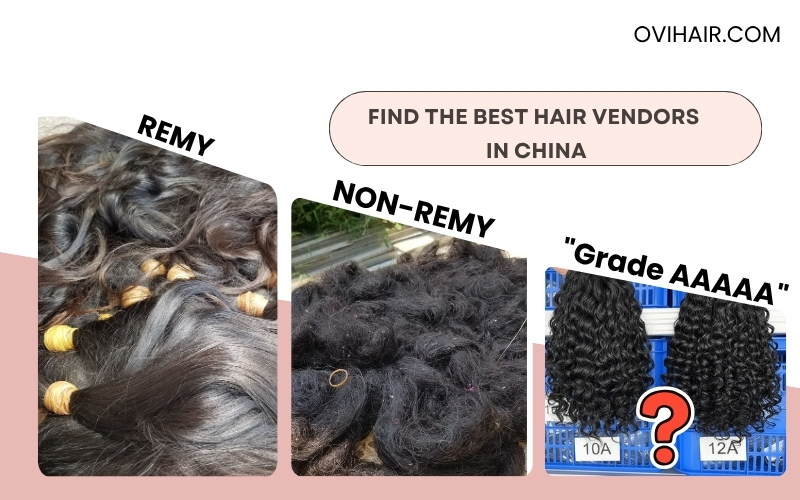
Remy hair keeps its cuticles fully intact and aligned in one direction, root to tip. That alignment prevents friction, tangling, and matting. It’s why Remy hair can last a year or more with proper care.
Non-Remy hair is collected from mixed sources, often floor sweepings or brush collections rather than single donors, so the cuticles run in random directions. Processors strip the cuticle with acid baths and coat the strands in silicone to fake a smooth texture. It feels silky on the shelf. Then the silicone washes out within four to six washes and the hair mats and sheds fast.
The numerical grading fallacy: No organization certifies hair at “10A” or “12A” grade. It’s a marketing convention individual sellers apply however they want, and grade numbers tend to climb every year simply because that justifies a higher price.
Field-Testing a Sample Shipment
Before committing to a bulk order, request physical samples and run these three checks:
- Burn test. Real human hair burns slowly, produces white ash, and smells like burning protein. Synthetic fiber melts fast and leaves a hard, black residue.
- Texture test. Under a loupe or microscope, cuticles should be visible and running in one direction. Run your fingers up against the grain; genuine hair catches slightly.
- Float/wet test. Hair heavily coated in silicone floats longer and feels unusually slick once wet.
11 Deceptive Practices to Watch For
Unverified brokers and dishonest suppliers rely on a fairly consistent playbook. Recognizing it protects your capital:
- False origin labeling: marketing standard Chinese or processed Indian hair as “Brazilian,” “Peruvian,” “Malaysian,” or “Russian” to justify a markup.
- Overstated processing claims: selling chemically treated, acid-bathed hair as “100% unprocessed raw virgin hair.”
- Misrepresented bundle length: shipping untrimmed, thin-ended bundles labeled at maximum length.
- Weight shorting: underweighting bundles or padding them with heavy rubber bands to hit the target weight on a scale.
- Fullness exaggeration: blending in short human hair or synthetic filler to fake double-drawn fullness in a single-drawn bundle.
- Fabricated factory presence: using stock photos of factories or production floors while operating as an unregistered home-based broker.
- Unverifiable ethical sourcing: hair procured from unauthorized regions or vulnerable populations with no supply chain documentation. Buyers should be especially cautious of sourcing linked to Xinjiang, which faces import restrictions and customs seizures in the US and other markets.
- The “single-donor” myth: a standard bundle weighs 100g, but a single donor’s ponytail typically yields only 30–80g. A true single-donor 100g bundle is the exception, not the rule — treat that claim with skepticism.
- Overstated longevity: promising a two-year lifespan on hair that’s chemically processed enough to mat within weeks of normal use.
- Underpriced “raw” hair: genuine raw human hair typically wholesales between $150 and $500 per kilogram; pricing well below that range usually signals blended synthetic or non-Remy stock.
- False direct-factory claims: a middleman presenting themselves as the manufacturer while quietly adding a 15–30% markup to the invoice.
A 5-Step Verification Framework for Vetting Chinese Suppliers
This is the core of sourcing safely: verifying a supplier through China’s own public business records before sending any money, rather than relying on what they tell you.
Step 1: Request the Unified Social Credit Code.
Every legitimate Chinese business has an 18-character Unified Social Credit Code tied to its business license. A supplier that hesitates to provide this immediately is a warning sign.
Step 2: Run a background check on GSXT.
Enter the code into the National Enterprise Credit Information System at gsxt.gov.cn. Check the registration date, registered capital, and legal representative. Manufacturers with real production facilities typically carry substantial registered capital; a company registered with the legal minimum (around RMB 100,000) is more likely to be a trading broker than a factory.
Step 3: Check litigation and compliance history.
Search the company name on creditchina.gov.cn and China Judgments Online for active disputes with other buyers, tax compliance issues, or administrative penalties.
Step 4: Conduct a live factory audit.
Cross-reference the listed address on Baidu Maps or Google Maps, then request an unannounced live video tour of the production floor and warehouse. A supplier that repeatedly delays or refuses this is very likely a trading company, not a manufacturer.
Step 5: Use escrow and put specifications in writing.
Never pay 100% upfront on a first order. Use a secured payment method such as Alibaba Trade Assurance, and write explicit quality specifications — hair type, weight tolerance, length, processing method — directly into the purchase agreement.
How this plays out in practice: One recurring pattern among importers who’ve been burned is a supplier that provides glossy factory photos and a fast quote, but stalls for days when asked for a live video walkthrough or a Unified Social Credit Code. That stall is usually the clearest signal available — legitimate manufacturers with nothing to hide tend to volunteer this information without much friction, since they’re asked for it constantly by other buyers doing the same diligence.
Final Sourcing Checklist for B2B Hair Importers
Before wiring bulk funds to any supplier:
✅ Define your target market tier (budget-processed hair vs. luxury cuticle-intact raw hair).
✅ Order small sample batches of the exact SKU and run burn, wash, and heat tests.
✅ Request the Unified Social Credit Code and cross-check it on GSXT.
✅ Require a live, unannounced video tour of the factory floor and raw material storage.
✅ Calculate true landed cost, including shipping and customs duties under US ITC Harmonized Tariff Schedule (HS Code 6704).
✅ Pay through secured escrow or Trade Assurance, with written quality specs in the contract.
A Note on Sourcing Beyond China
Domestic hair collection within China has declined significantly as the country has modernized economically, which means most Chinese factories now import raw hair from India, Myanmar, and elsewhere in Southeast Asia and process it locally to meet export demand. That’s not unique to China, it’s the norm across the industry, but it’s worth knowing as context when a vendor markets hair as “100% Chinese” or “locally sourced,” since true domestic-origin hair at scale is increasingly rare.
Some Western buyers have also started sourcing directly from Vietnam, where suppliers work with less chemically processed, naturally thicker-cuticle hair. It’s a smaller and less industrialized supply chain than China’s, with fewer manufacturers and higher relative prices, so it tends to suit buyers prioritizing minimal processing over scale and price: it’s an alternative worth being aware of, not a replacement for the sourcing process above.
Conclusion
Most of the risk in this market comes down to how much a supplier is willing to show you before you’ve paid them. A factory with nothing to hide will hand over its credit code without hesitation and put a camera in the production room on short notice. A trading company posing as one won’t, and that reluctance tends to show up early, usually before the first sample order ships. For most salon owners, distributors, and e-commerce brands, China is still the right place to build a supply chain. It’s just not a market where you can skip the paperwork.
